
Foreign exchange trading alert: The US dollar hits a two-and-a-half-month high, pay attention to Powell’s speech, the Bank of England’s interest rate hike expectations have cooled, suppressing the pou
Huitong Finance APP News - In the early trading of the Asian market on August 25, Beijing time, the U.S. dollar index surged slightly, once reaching a high of 104.13 since June 8, and is currently trading around 104.10. The U.S. index closed up 0.59% on Thursday at 103.98. Investors are awaiting Federal Reserve Chairman Jerome Powell's remarks at the Jackson Hole Economic Policy Symposium on Friday to get a sense of the central bank's thinking on whether it is close to completing a rate hike and how long it plans to keep rates high.
Stuart Cole, chief macroeconomist at EquitiCapital, said: "I think what we saw was mainly a position adjustment before the Jackson Hole symposium." He said: "No one knows what Powell will say, so the default currency to buy is the dollar."
Philadelphia Fed President Harker and Boston Fed President Collins on Thursday tentatively accepted a surge in bond market yields as a complement to the Fed's efforts to slow economic growth and return inflation to its 2% target. They also noted that further interest rate hikes were likely not needed.
Data on Thursday showed that the number of people filing for unemployment benefits in the United States fell for the second consecutive week, as labor market conditions remained tight despite the Federal Reserve's aggressive interest rate hikes.
Cole said: "I think the jobless claims report may also have provided some support for the dollar. These data are not as weak as people feared and have somewhat offset the impact of the downward revision of yesterday's employment data." He said: "But overall, the market reaction to these data has been quite muted, indicating that the Jackson Hole seminar is the main focus."
This week’s weaker-than-expected data from Europe and the United States dampened investor appetite for riskier currencies and supported the safe-haven dollar.
The Turkish lira hit its highest level in two months against the U.S. dollar on Thursday, up about 5.53% to 25.64, after the Turkish central bank raised the one-week repo rate from 17.5% to 25%, much higher than expected. The median estimate among economists is that the policy rate will be raised to 20%.
After Turkish President Erdogan appointed former Wall Street banker Elkann as governor, the Turkish Central Bank started a tightening cycle in June. Türkiye's central bank on Thursday reiterated its commitment to further tighten policy in a gradual manner if necessary, while announcing a sharp increase in the one-week repo rate by 750 basis points.
Piotr Matys, senior foreign exchange analyst at Touch Capital Markets, said: "Turkey's decision sends a very strong signal that the Turkish Central Bank is determined to curb inflation, and the market's initial reaction is very positive."
The pound fell against the dollar on Thursday, closing down 0.97% at 1.2598. Expectations for further interest rate hikes by the Bank of England have cooled, putting pressure on the pound. A drop in British factory output has put the economy on the path to recession, prompting markets to lower expectations for further interest rate hikes by the Bank of England. Market analysts say that if the Bank of England is unexpectedly dovish next month and keeps interest rates at 5.25%, rather than the 15th consecutive interest rate hike, the pound may take a hit, prompting speculators to sell long positions in the pound, dragging the pound down towards 1.2308 (May low).
The market predicts that the probability of the Bank of England keeping interest rates unchanged on September 21 is 12%, and the probability of raising interest rates by 25 basis points is 88%. In a survey released on Thursday, all 62 economists predicted the Bank of England would raise interest rates next month.
The latest news is that traders have reduced their bets on the Bank of England raising interest rates, and currently believe that the possibility of interest rates peaking at 6% is less than half.
The yen continues to be under pressure, with traders watching for signs that the Japanese government is preparing to intervene to support the yen as it did last year.
The U.S. dollar closed up 0.69% against the yen on Thursday, at 145.82. In early Asian trading on Friday, the U.S. dollar rose slightly against the yen, hitting a three-session high of 146.08, and is currently trading around 146.06. The euro fell against the dollar on Thursday, closing down 0.48% at 1.0810. The euro was pressured by the latest data showing the euro zone's economic recession deepened in August. Eurozone Purchasing Managers Index survey data released by S&P Global showed that the data fell to 47 in August from 48.6 in July, hitting the lowest level since November 2020. Usually a PMI below 50 indicates a recession. In the Asian market on Friday, the euro fell slightly against the US dollar, hitting a low of 1.0792, a new low since June 15.
Data also showed that the euro zone’s service industry fell into decline in August, which was the first contraction in euro zone service industry activity since December last year. The euro zone economy is shrinking at its fastest pace in three years as a sharp decline in manufacturing begins to spread to services.
Pantheon macroeconomists Claus Vistesen and Melanie Debono said in a report that whether the European Central Bank will raise interest rates in September is undecided, but the burden of proof now falls on the hawks. Negotiated wage growth in the euro zone held steady at 4.3% year-on-year in the second quarter, a figure that dovish ECB officials will take note of as a reason to end rate hikes.
Hawks, by contrast, will say the number is still too high, these economists say. The August PMI released on Wednesday also supports both views. Dovish officials say economic activity is falling sharply, but hawks believe accelerating wage growth in the services sector shows signs of second-round inflationary effects. But overall, if the ECB is not yet at the end of its tightening cycle, it is very close.
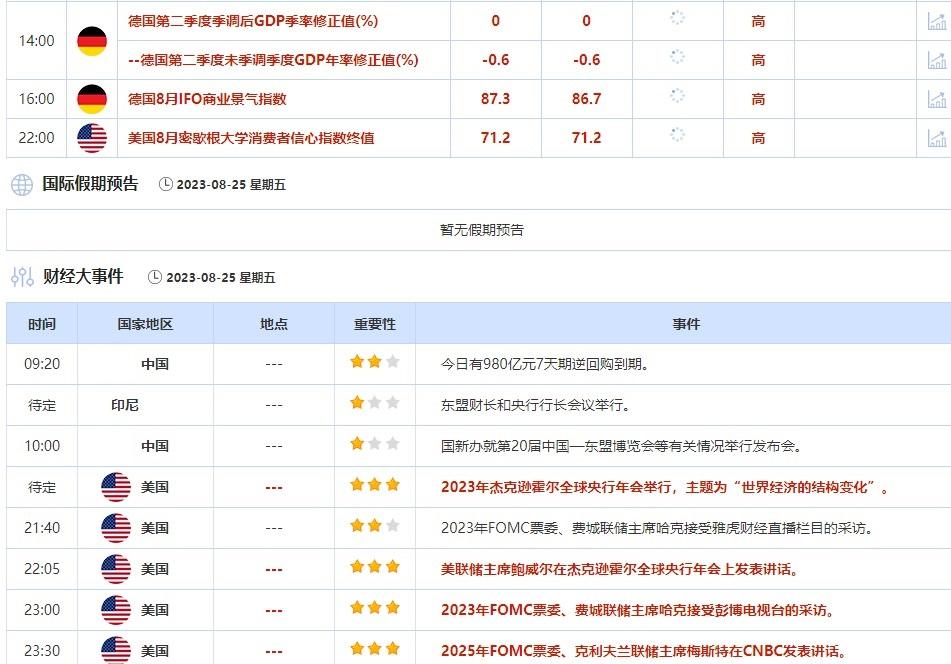
Friday’s key data and events
Summary of institutional views
1. Goldman Sachs: The Turkish central bank's unexpected interest rate hike is a "more powerful step" to raise the real interest rate to a positive range, which will make the Turkish lira more attractive;
2. Macro Intelligence 2: The Federal Reserve is expected to stick to its stance of “maintaining high interest rates for a longer period of time” this week;
①Macro Intelligence 2 analyst Julian Brigden said that Federal Reserve Chairman Powell's speech in Jackson Hole is unlikely to bring new elements to the outlook for U.S. monetary policy;
② He said: "They will continue to hold their ground because they do not want to ease financial conditions. They will continue to raise this sword of Damocles and indicate that they may raise interest rates by 25 basis points, while emphasizing that they will not cut interest rates soon;"
③Brigden expects inflation to remain above target, so there is no room for dovishness. He said that investors have not realized that "keeping interest rates high for longer" means "longer than the market concept of 'longer'";
3. Analysts list three possible scenarios for Powell’s Jackson Hole speech and the impact on the dollar;
① At 22:05 on August 25, Beijing time, Federal Reserve Chairman Powell will deliver a speech at the Jackson Hole Annual Meeting of Global Central Banks. Market analyst Yohay Elam listed three possible scenarios and their impact on the US dollar;
②The most likely scenario is that Powell emphasizes a high degree of uncertainty and only acknowledges recent developments. Investors may be concerned about this, refusing to comment on future policy and insisting that data will determine everything, in which case the dollar will rise;
③If there is a hawkish result, that is, Powell emphasizes the recent strength of the economy and dismisses the recent improvement in inflation, the dollar will rise and gold will fall;
④If there is a dovish outcome, that is, if Powell celebrates the decline in inflation and the imminent decline in underlying price pressures, this possibility is very low. If it happens, the dollar will plummet and gold will rise.
